AI Agents
AI Agents Need an Identity Layer, Not a Bypass
AI Agents become valuable when they can read context, call tools, and complete real work. That is exactly why they need to enter through the same identity, access, and evidence model as the rest of the business.
Most AI Agent pilots start with a narrow task: read a case, update a record, summarize a customer history, prepare an approval, or call an internal tool. The first demo is usually easy. The production question is harder: what happens when the Agent is connected to the systems the business depends on?
At that point the Agent is no longer a chatbot. It is a new actor in the operating model. Leadership needs clear answers: who is it acting for, which data is in scope, which tool calls are allowed, which approval was required, how long access lasts, how access is revoked, and where the evidence lands afterward.
Why Agents need access control
Agents combine three things that traditional access models often separate: broad context, delegated intent, and fast execution. A person might open one customer record. An Agent may read the case, pull related history, call a workflow, draft a decision, and update the system that triggers the next step.
That reach is useful only when it is bounded. Agent access needs delegated identity, action-level permissions, time limits, approval records, policy checks, and a shared audit trail. Otherwise, the organization gets automation without ownership.
The wrong pattern: a clever Agent with special access
The fragile pattern is familiar: an Agent gets an API key, a broad service account, a few direct integrations, and enough permissions to make the demo work. It looks fast because it skips the hardest questions.
Who is the Agent acting for? Which tenant, customer, record, or purpose is in scope? Which tools may it call? What expires? What gets revoked? What will the auditor see? If those answers live inside prompt glue and custom integration code, the Agent is already becoming another shadow access path.
The better pattern: controlled delegation
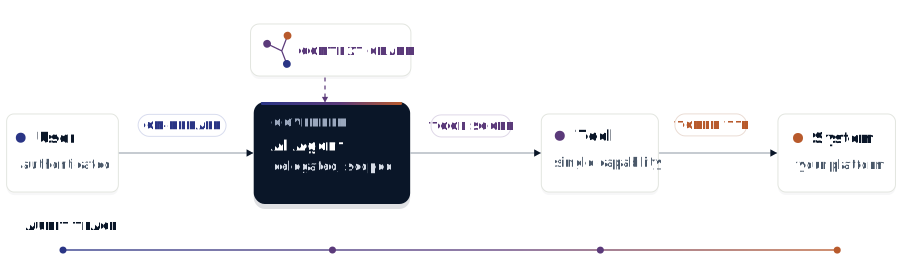
The better pattern is controlled delegation. A person or workflow authorizes a specific task. The Agent receives limited access for that task. The access path checks policy, supplies only the context needed, records what happened, and gives operations a way to stop it.
In practice, that means Agents should enter through the same federation and identity boundaries as humans and services. They need a stable way to inherit user intent, tenant scope, role constraints, tool permissions, and audit requirements. If the Agent needs identity context, that context should come from a governed model rather than direct lookups scattered across systems.
Context has to be reliable
Access control is not enough if the underlying data is wrong. An Agent built on stale HR records, outdated roles, mismatched SaaS state, or inconsistent customer data will make confident mistakes.
This is why integration discipline becomes important again. Records need owners. Mappings need review. Sync failures need visibility. Reconciliation, dry-runs, approvals, rollback controls, and per-record history reduce the chance that bad source data becomes automated action.
Some actions need stronger proof
Not every Agent task has the same risk. Reading a case summary is different from changing payout details, recovering an account, approving access, or updating a regulated customer record. Sensitive actions need stronger proof and clearer permission.
Under the hood, this usually means established standards and explicit evidence: OAuth, OIDC, token exchange, sender-constrained tokens, step-up verification, consent records, and audit telemetry. The point is not to make every Agent flow heavyweight. The point is to make the sensitive paths inspectable before they become incidents.
What good looks like
A mature Agent access model feels almost ordinary. A user or workflow delegates a task. The Agent receives a narrow permission. The system knows which data is in scope. Sensitive actions ask for stronger proof. Source data has an owner. Every tool call leaves evidence. Revocation is a normal operating path.
That is the difference between an impressive demo and an operating capability. The hard questions are not anti-AI. They are what lets AI Agents touch important systems without becoming the next unmanaged access path.